
- CALIFORNIA BATTERY STORAGE SPECIALISTS
BE THE FIRE
STORE THE SUN
SOLARI STORAGE
A Battery Only, Solar Second Focused Sales Organization
From the co-founder
What the utility companies aren't telling you
Seven minutes with Stephen Waltrip | No pitch
Your electric bill is not just electricity. It carries wildfire charges, decommissioning fees and adjustments that never went to a vote. Meanwhile the grid is being asked to carry solar, EVs, data centers and new construction it was never built to handle. Stephen breaks down how California got here, what the utilities pay for stored power when they need it most, and why a battery changes who is holding the leverage at 4 p.m.
Who we are
Battery only first.
Solar second.
Solari Storage helps California homeowners add storage to the solar they already have. Most of our customers already have solar. Adding a battery is the missing piece.
We start with the battery that completes the system you already have. We only recommend adding more solar if your usage and goals truly require it. Most homeowners do not need more panels. They need storage. This focus keeps the project simpler, faster and more cost-effective, while still delivering the backup and bill savings people actually want.
We work with four battery platforms: Tesla Powerwall 3, Lunar System, FranklinWH aPower 2 and the SolarEdge Home Battery. Every utility in California offers different incentives and rebates, and we stay current on all of them to reduce the net cost of your system. We do not perform installations; a licensed contractor carries those out.
We operate in California only. Every rate structure, incentive and interconnection rule we work with belongs to this state.
-
01 / Focus
Battery only first
We only recommend adding more solar if your usage and goals truly require it. Most homeowners do not need more panels.
-
02 / Territory
California only
Every utility here offers different incentives and rebates. We stay current on all of them and use the strongest programs available for your utility.
-
03 / Method
All we need is your bill
A recent utility bill is enough to get started. We work from your real usage and rate plan, then build a quote around your situation.
The process
From first call
to powered up
Five stages. No surprises. And an honest answer at the point where most companies would keep selling.
-
Stage 01
The call
Send us a recent utility bill. We read your actual usage and rate plan, not an estimate, and tell you whether storage makes sense for your home.
-
Stage 02
The design
We size the battery to your evening load and your backup priorities, using the platform that fits your existing equipment. If your home does not need what we sell, we say so.
-
Stage 03
The programs
We identify every incentive, rebate and funded program your utility currently offers, and we file the paperwork on your behalf.
-
Stage 04
The install
A licensed contractor carries out the installation. We manage the schedule, the permits and the utility interconnection so you are not chasing anyone.
-
Stage 05
Powered up
Your system comes online. You keep your own solar for the evening peak, and you have backup power when the grid goes down.
The 2026 Reality
What actually changed in 2026
Batteries are now the solution. Here is the simplified picture of what changed and why storage is essential.
What broke solar-only economics
- The federal 30% residential tax credit ended after 31 December 2025. Cash or loan purchases in 2026 get no federal credit.
- Under NEM 3.0, the Net Billing Tariff, excess solar you export to the grid is only worth about 5 to 8 cents per kWh, roughly 75% less than the old full retail rate.
- Evening peak rates stay high, often 35 to 62 cents per kWh depending on your utility and the season.
A solar-only system produces a lot of power in the middle of the day when you do not need it, sells that power for almost nothing, then forces you to buy expensive power from the utility in the evening when everyone is home. Paybacks stretched to 11 to 16 years in many cases.
Why batteries fix it
A battery lets you keep the energy you generate instead of giving it away cheaply.
- Charge the battery with cheap midday solar.
- Discharge it during the expensive evening peak hours, typically 4 to 9 PM.
- You avoid buying high-priced grid power and get the full retail value of your own solar.
This turns a weak solar-only investment into a strong solar plus battery system, with paybacks often in the 7 to 11 year range, plus backup power during outages and Public Safety Power Shutoffs.
The bigger picture
California's grid has a classic duck curve: too much solar midday, then a steep climb in demand after sunset. Data centers, EVs and building electrification are adding even more evening load and overall strain.
The state has already built over 21,000 MW of battery storage, because it is the fastest, most flexible way to shift solar energy to when it is actually needed. Utilities are adjusting rates and interconnection rules around this reality.
Here is what it comes down to
New solar customers are now almost always designed around self-consumption plus storage. Solar alone is no longer the complete answer. Solar paired with batteries is.
Solari Storage sells and specifies home battery systems. We do not install solar or batteries; our install partners handle fulfillment. We are not tax advisers. Confirm your own position with a qualified professional.
The 8-Cent Problem
They buy at 8¢. They sell it back at 62¢.
Your panels make power at noon, when nobody's home. Your utility takes it for about eight cents. Then at six in the evening, when the AC is running and dinner's on, they sell it back to you for up to sixty-two. A battery is how you stop making that trade.
What they pay you
Average credit for exported power under NEM 3.0. It used to be around 30¢.
What they charge you
SDG&E's summer peak. PG&E and SCE run 52 to 59¢ on most time-of-use plans.
When they charge it
The five hours your panels have stopped producing and your whole family is home.
Who's already fixed it
Share of new California solar customers now installing a battery.
Wood Mackenzie / SEIA, 2026
Your gap depends on your utility, your tariff and your usage. Send us a recent bill and we'll show you yours, including if the numbers say don't buy.
IF YOU ALREADY HAVE PANELS
Why solar alone stopped being enough
If you already have panels, you have probably felt this. Your system was sized and sold when exported power was worth close to what you paid for it. It still produces exactly what it always did — the rules changed underneath it.
Panels do not store anything. Production drops off around sunset, and your most expensive hours start right after. So the power you generate at noon leaves your property, and the power you need at seven comes back from the utility at their price.
Adding a battery to an array that already exists is usually the cheapest energy upgrade available in California. The panels are paid for. The roof work is done. What is missing is somewhere to put the power until you need it.
Most existing systems can take an AC-coupled battery regardless of inverter brand or age. We check compatibility before we quote anything
which is why we start with your bill, not a satellite photo.
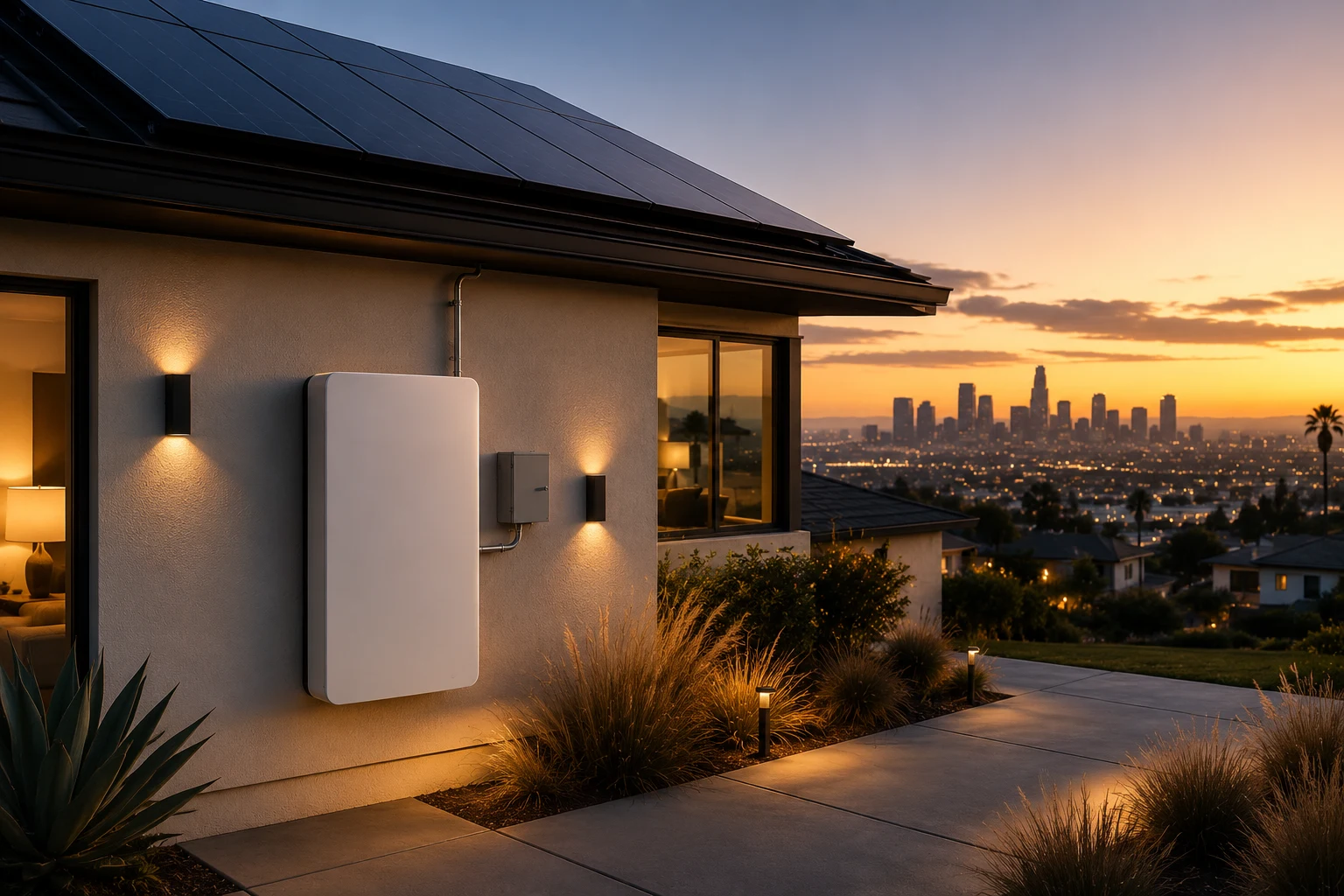
The lineup
Four platforms. One of them fits your house.
Most companies sell one battery, so that is the one they recommend. We work with four, and we will tell you which one your house actually needs, even when it is the cheaper one.
Tesla Powerwall 3 13.5 kWh · 11.5 kW
The proven one. Tesla publishes 13.5 kWh usable capacity and 11.5 kW continuous output, which is the highest continuous output of the four platforms we work with. That matters in an outage: it means the battery can carry heavier household loads at once rather than making you choose which circuits stay live.
Storm Watch monitors weather data and charges ahead of forecast severe weather, so you are full before an outage rather than after it. There is also an integrated solar inverter option, which keeps the equipment count down on a new system.
Best for whole-home backup and the most polished app
Lunar System 15 to 30 kWh · 9.6 kW
The flexible one. Because the capacity is modular, the system gets sized to your actual evening consumption instead of rounding up to a fixed block, and it can be expanded later if you add an EV or electrify your heating.
Its optimization software manages when the battery charges and discharges against your rate plan, and its load control lets you decide what stays powered during an outage rather than treating the house as one circuit.
Best for precise sizing and usage that will grow
FranklinWH aPower 2 15 kWh · 10 kW
The clean retrofit. aPower 2 is AC-coupled, so it works alongside most existing solar inverters rather than requiring them to be replaced. If you have a working system on the roof already, that is the difference between adding a battery and rebuilding the whole installation.
Units can be stacked, so larger homes and higher-consumption households can add capacity without switching to a different system. FranklinWH states a 15-year warranty on the unit.
Best for existing solar from any manufacturer
SolarEdge Home Battery 9.7 kWh · 5 kW / 7.5 kW peak
The obvious one if you already have a SolarEdge inverter. Its DC-coupled design avoids a conversion step that costs efficiency in AC-coupled retrofits, so more of the solar you generate ends up stored rather than lost in the round trip.
Monitoring runs through the SolarEdge platform you are already using, and the efficiency advantage suits shifting energy against time-of-use rates rather than only holding it for outages.
Best for homes with SolarEdge equipment installed
Which one is right for your house
It depends on four things: the solar equipment you already have, your household loads, what you need backed up when the power goes out, and the incentives available where you live. There is no single best home battery, which is why we work with four rather than recommending the one we happen to sell.
We start with a recent utility bill, read your real usage and rate plan, and specify from there. If your home does not need what we sell, we say so.
Book an appointment for an official quote and a breakdown built around your specific situation. All we need to get started is your utility bill.
Schedule your appointment →Why Solari
Four reasons homeowners pick us
We are a small California company with two founders whose names are on the door. That has some disadvantages, and we will be straight with you about those too. Here is what it gets you.
More about us →-
01
We tell you what expired
The federal 30% residential tax credit ended after December 31, 2025. Cash or loan purchases in 2026 get no federal credit. Most California solar sites still say otherwise. We will tell you exactly what you qualify for in 2026 and exactly what you do not, before you ask.
-
02
Batteries are what we do
We are battery only first, solar second. Storage is the whole business, which is why we work with four platforms instead of one, and why we can tell you when the cheaper one is the right one for your house.
-
03
We file the paperwork
Every utility in California offers different incentives and rebates, and we stay current on all of them. We handle the application and the follow-up so the money actually reaches you, rather than pointing you at a website.
-
04
You get a straight answer
We start with your actual utility bill, not an estimate. If your home does not need what we sell, we say so, and we will not build an incentive into your quote that never arrives.
GET AN HONEST ANSWER
FIND OUT IF BATTERY STORAGE
IS RIGHT FOR YOUR HOME
Tell us where you are and which batteries you are curious about. We will look at your location, your utility and your options, then tell you plainly whether storage makes sense for your home. If it does not, we will say so.
- 01 You send your details Takes about a minute. No account, no obligation.
- 02 We review your situation Your utility, your rate plan and the programs you actually qualify for.
- 03 You get a straight answer A recommendation with the numbers behind it, or an honest no.
Find out what a battery actually does for your bill
No pressure, no fake urgency, no incentive that expired last year. Just your numbers, your rate plan and an honest answer about whether this is worth doing.
FAQ
Frequently asked questions
Is the 30% federal solar tax credit still available in 2026?
No. Section 25D expired on December 31, 2025 under the One Big Beautiful Bill Act. Systems placed in service in 2026 do not qualify for it. Any company still quoting 30% on a cash or loan purchase this year is wrong.
I paid a deposit in 2025 but installed in 2026. Do I still get the credit?
No. The IRS treats the expenditure as made when installation is completed, not when you paid. If the system was placed in service after December 31, 2025, the credit does not apply. This is the detail most sites get wrong, and it is the one that costs people money.
I installed in 2025 but could not use the whole credit. Is it lost?
No. Carryforward survives. If your tax liability was too small to absorb the full credit in the year you installed, you can carry the remainder forward to later tax years.
Why do some California solar companies still advertise 30%?
Some sites are simply out of date. Others are referring to a commercial-side credit claimed by a finance company under a lease or PPA, which is structurally different from a credit you claim on your own tax return. If you are buying outright, that credit is not yours.
What incentives are actually left in California in 2026?
It depends on your utility. Every utility offers a different set of programs, and they open and close without much notice, which is why we check yours rather than quoting a general figure. SGIP, California's state storage rebate, is not currently accepting general-market applications. The budgets ran out at the end of 2025. We have filed SGIP applications for homeowners before and we will again if it is refunded. Send us a recent bill and we will tell you what is open where you live.
Which battery is best?
None of them, in general. They suit different houses. We work with four platforms: Tesla Powerwall 3, Lunar System, FranklinWH aPower 2 and the SolarEdge Home Battery. Powerwall 3 has the highest continuous output of the four. Lunar scales in modules rather than whole units. FranklinWH is AC-coupled, so it retrofits onto most existing solar. SolarEdge is the efficient choice if you already have a SolarEdge inverter. The deciding factors are your peak load, how much backup you want, your existing equipment and your available space.
Can I add a battery to solar I already have?
Usually yes, and it is normally the cheapest energy upgrade available in California. The panels are paid for and the roof work is done. Most existing systems can take an AC-coupled battery regardless of inverter brand or age. We check compatibility before we quote anything, and we will tell you if your system is one of the exceptions.
Do I need a permit for a home battery in California?
Yes. Home storage requires a building permit and utility interconnection approval. We manage both, along with the schedule, so you are not chasing your city's permitting office or your utility.
What does a home battery cost in California?
We do not publish a price, because a number without your bill attached is a guess. The main variables are usable capacity, how much work your electrical panel needs, and how far the battery sits from it. Send us a recent utility bill and we will build a real quote around your situation, including telling you if the numbers say do not buy.
Do I need a battery with solar in California?
Under NEM 3.0, usually yes if you want the system to pay back. Exported power is now compensated well below the retail rate you pay, so the value is in storing your own generation and using it during the evening peak rather than selling it. If your usage pattern means a battery would not pay for itself, we will say so.